
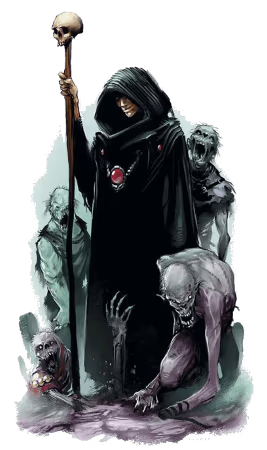
Class Traits
Role: Striker. A ranged Arcane Striker, with secondary controller abilities, who’s attack often weaker or hamper the target in some way, that can summon minions to aid them.
Power Source: Necromancy, Limit Break. You gain your magical power from a pact you forge with a powerful, supernatural force or an unnamed entity.
Key Abilities: Charisma, Intelligence, Dexterity
Armor Proficiencies: Cloth
Weapon Proficiencies: Dagger, Quarterstaff
Implements: Staves
Bonus to Defense: +2 Will
Hit Points at 1st level: 10 + Constitution score
Hit Points per Level Gained: 4
Healing Surges per Day: 6 + Constitution modifier
Trained Skills: Arcana. From the class skills list below, choose three more trained skills at 1st level: Bluff (Cha), Diplomacy (Cha), History (Int), Insight (Wis), Religion (Int), Stealth (Dex).
Class Features: Cantrips, Summon Minion, Shadow Walk, Pack Leader, Scourge
Class Features
All of the following are class features of the necromancer.
Cantrips
Cantrips are minor spells you gain at 1st level. You can use the disrupt undead, ghost sound, light, and prestidigitation cantrips as at-will powers.
Shadow Walk
On your turn, if you move at least 3 squares away from where you started your turn, you gain concealment until the end of your next turn.
Pack Leader
You and your minions gain a +1 bonus to attack rolls against targets that you are closer than them to or that you are adjacent to.
Scourge
If your player character is unable to take attack actions, such as if you are stunned, unconscious, or dead, your minion may attack on it’s own accord, adding your Constitution modifier, implement and other bonuses to the attack and damage rolls of the attacks it makes. When choosing the Zombie Minion option, you can summon a zombie and two extra ghouls with your “Summon Minion” Necromancer Class feature. However, you can still only use the At-will “Minion Attack” once per turn, with one minion. Furthermore, unless you have used the At-will “Minion attack” during your turn, the other ghouls summoned by your Scourge ability cannot make extra attacks. So, if you were to use another necromancer power instead of “Minion attack”, only one minion could attack per turn
Summon Minion
You can summon a minion under your control to provide extra damage, a number of times per day equal to your Minion Threshold. The minion lasts until the end of the day or until it is killed, and if it is killed can be resummoned only after an extended rest. The minion can make move and minor actions separately from you, but you must take standard actions for the minion; the minion has the same limitations on actions as a player character. Minion attacks are most often done through other Necromancer powers, such as “Minion Attack”. The exception to the rule is the Zombie and Imp minion, which allow you to boost your damage in addition to your warlock attacks by attacking separately. As it is a minion of yours, it cannot speak to most creatures and does not have the common language, although it can speak to other undead and Necromancers. You can communicate with your minion Telepathically out to a range of 20 squares. The minion’s attributes, capabilities, and damage are all determined by the minion of your choice. When minions die, they disappear for the rest of the day, but can be re-summoned the next day. Minions never truly die, as they simply return to the netherworld to heal, or can be reanimated. You gain a minion threshold, which limits how many minions you can summon or resummon per day, which at heroic tier is 2 minions per day. At level 11, you can summon a minion 3 times per day, and at level 21, you can summon a minion 4 times per day. You still cannot have more than one minion summoned at a time, unless a power otherwise specifies. Certain powers (especially daily powers), allow you to summon additional minions. However, you can only summon these additional minions a number of times equal to your daily value. So, for instance, if you summoned a Zombie minion one time in a day at the heroic leve, you could only summon one daily minion for that day (although you could still use that daily power, just not summon the minion). Summoning daily minions often dismiss your primary minion, but this minion can be resummoned without counting towards your daily value (unless otherwise stated).
Necromancer minions are an important part of the Necromancer’s damage. For all intents and purposes, they count as another creature, and thus provide flanking benefits for combat advantage. They are capable of opportunity attacks. In addition to this, they provide extra damage when prompted to attack. Some minions are designed to be incredibly powerful and do damage in place of the necromancer’s attacks, while others are designed to boost the damage of the Necromancer, more or less replicating abilities like similar striker classes. They also allow multiple targets to be targeted, giving them the ability to pick off multiple enemies at once. Necromancer minions are an extension of the Necromancer themselves; any creature they kill or do damage to count as the Necromancer, and their attributes are based on the Necromancer’s own. Further, they use the Necromancer’s abilities to determine their own attack and damage rolls, as well use a fraction of the Necromancer’s health. Their defenses and skill bonuses also improve by the Necromancers, or 1/2 the Necromancer’s level. Any armor enhancement bonuses you receive from your equipment are also added to the minion’s defense bonuses. Minions gain your implement enhancement bonus to attack rolls; as your weapon can serve as an implement, this bonus can be the equivalent of your weapon. They do not however gain any special effects from your weapon or implement when attacking, just the enhancement bonus to attack rolls. When a minion could otherwise spend a healing surge, it spends one of your healing surges and regains hitpoints equal to your healing surge value, rather than their own. Every minion can once per encounter take a second wind action, and can regain hitpoints equal to your healing surge value and a +2 bonus to all defenses. However, the minion cannot attack in the same turn it has used it’s second wind.
Summon Minion (Necromancer Attack 1)
You summon an arcane minion of the damned, eager to follow your every command.
At-Will ✦ Necromancy, Necrotic
Minor Action ✦ Ranged 10
Target: One unoccupied square
Effect: You can summon an ordinary minion to fight by your side.
Special: You can only summon a number of minions per day equal to your minion threshold. In addition, you can only summon one minion at a time (unless another power specifies otherwise).
Note: Your minion’s attack is treated as an implement attack by you. So for instance if a feat were to provide a bonus to the attack roll, such as “implement expertise”, you would add the bonus to the attack roll of the minion. The minion still uses it’s damage, targets the defense specified with it’s attack, possesses the same range, and does the same damage as it would otherwise. In the list of minions you can find their attack features.